
Walk into the finance conversation at almost any small-to-midsize nonprofit and you'll find the same pattern: a checking account with six figures sitting at 0.01% interest, a board that's terrified of "risking donor money," and an executive director who's never been taught that there's a responsible middle ground between day-trading the operating budget and burying it in a mattress.
This is one of the most common — and most fixable — inefficiencies in the nonprofit sector. Cash sitting idle isn't "safe." It's a slow, guaranteed loss to inflation, and it's a missed opportunity to generate revenue that could fund another year of programming, another staff position, or a cushion that keeps the lights on during the next funding gap.
Here's how organizations can think about this more strategically — without gambling with the mission.
First, Separate Your Cash Into Buckets
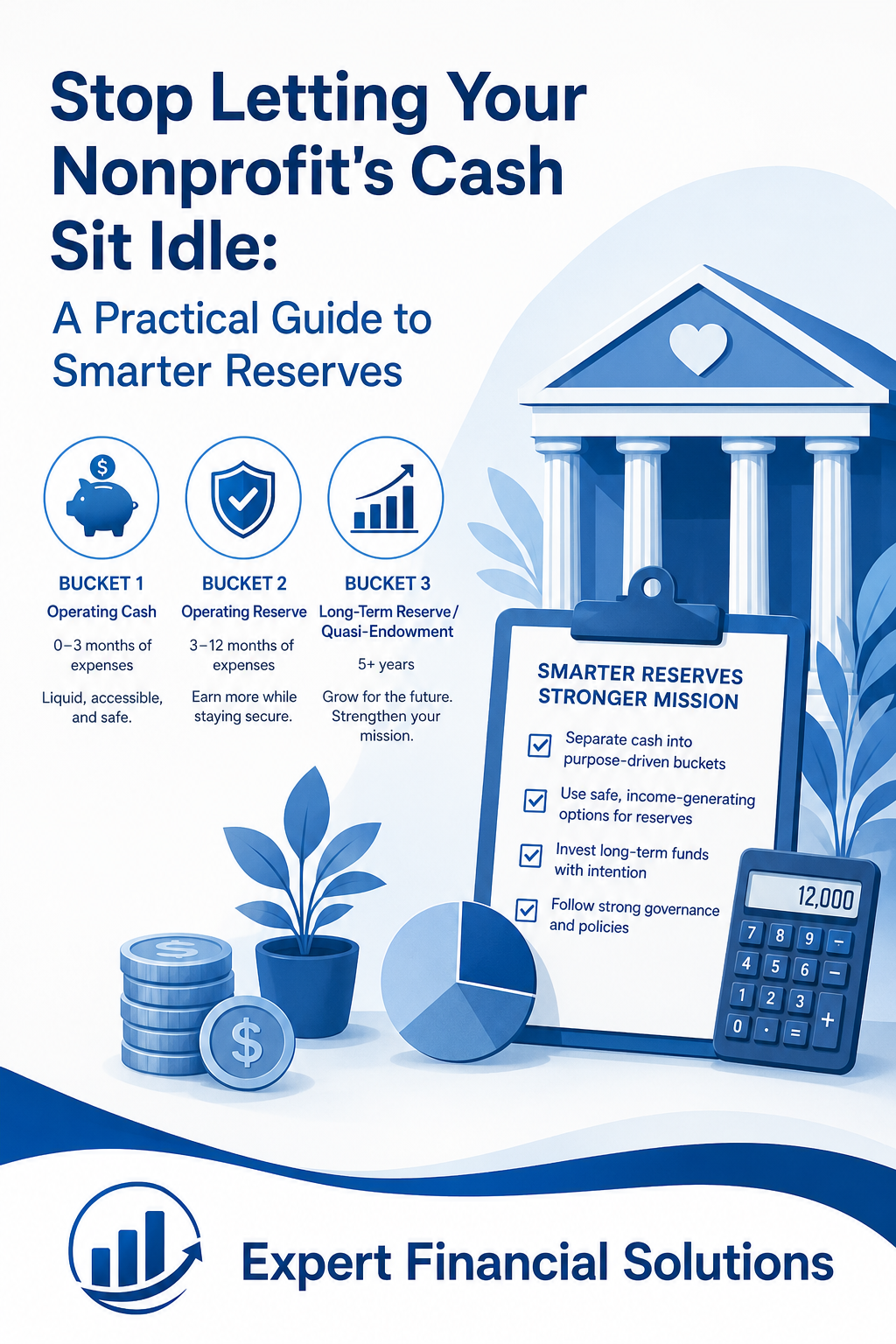
The single biggest mistake nonprofits make is treating all their cash as one undifferentiated pool. Before you can invest anything, you need to segment your funds by purpose and time horizon. A simple three-bucket model works for most organizations:
Bucket 1: Operating Cash (0–3 months of expenses) This is your payroll-and-rent money. It needs to be liquid, accessible same-day or next-day, and fully insured. This stays in a checking or high-yield business savings account. Nothing fancy here — the job of this money is availability, not growth.
Bucket 2: Operating Reserve (3–12 months of expenses) This is the cushion nonprofit finance experts (and rating agencies like Charity Navigator) recommend holding to survive a bad grant cycle, a delayed government contract, or an economic downturn. This money doesn't need to be touched tomorrow, but it might need to be touched this year. This is where a lot of organizations are leaving real money on the table.
Bucket 3: Long-Term Reserve / Quasi-Endowment Funds the board has designated for long-term stability — sometimes called "board-designated funds" — that aren't needed for years. This bucket can tolerate more volatility in exchange for real growth.
What to Actually Do With Bucket 2: The Reserve
This is where most nonprofits are leaving the most money on the table, because it's sitting in the same checking account as Bucket 1 out of inertia.
Example — High-Yield Savings / Money Market Funds A nonprofit with $300,000 in operating reserve sitting in a standard checking account earning near-zero interest could move it to an FDIC-insured high-yield business savings account or a government money market fund. Even a conservative 4% annual yield turns into $12,000 a year — enough to fund a part-time program coordinator — with essentially the same liquidity and safety profile as the checking account it replaced.
Example — CD/Treasury Laddering Say that same organization knows it won't need $150,000 of that reserve for at least 6–18 months. Instead of one lump sum sitting still, it could ladder the funds: $50,000 in a 6-month Treasury bill, $50,000 in a 12-month CD, $50,000 in an 18-month CD. As each matures, the organization either reinvests it or uses it, and it's never locking up money it might need on short notice. Treasuries also carry the practical benefit of being state-tax-exempt in most states, and they're backed by the federal government — an easy sell to a risk-averse board.
Example — FDIC Sweep Programs For organizations with reserves above the $250,000 FDIC insurance limit at a single bank, many banks now offer "insured cash sweep" (ICS) programs that automatically spread deposits across multiple banks, keeping every dollar FDIC-insured while it earns interest — without the nonprofit having to open a dozen separate bank accounts. This solves the "we can't put all our eggs in one basket" concern boards often raise.
What to Do With Bucket 3: The Long-Term Reserve
Money that genuinely won't be touched for 5+ years can be invested more like an endowment — with a diversified portfolio designed for growth, subject to a formal investment policy.
Example — A Simple Board-Designated Fund Imagine a nonprofit that receives an unusually large one-time bequest of $500,000. Rather than spending it down over two years or letting it sit in cash, the board votes to designate it as a long-term reserve and adopts a spending policy — say, drawing no more than 4–5% annually, similar to how university endowments operate. The remaining balance is invested in a diversified mix (for example, 60% low-cost index funds across equities, 40% bonds), managed either through a nonprofit-focused investment advisor or a donor-advised platform. Over a decade, that fund can both provide a reliable annual distribution and grow ahead of inflation — turning a one-time gift into a permanent source of revenue.
Example — Socially Responsible / Mission-Aligned Investing A conservation nonprofit uninterested in indirectly funding fossil fuel companies through its investment portfolio could work with an advisor to build an ESG-screened or mission-aligned index fund allocation. This lets the organization grow its reserves without contradicting its own mission — increasingly common and no longer a meaningful performance sacrifice compared to standard index investing.
The Governance Piece Nobody Wants to Do (But Must)
None of this should happen informally. Before moving a single dollar, a nonprofit needs:
A written Investment Policy Statement (IPS) — approved by the board, defining what the reserve is for, acceptable risk levels, allowed asset classes, and who has authority to make changes.
A Reserve Policy — separate from the IPS, defining the minimum/target reserve level (commonly 3–6 months of operating expenses) and the specific conditions under which the reserve can be drawn down.
A Finance or Investment Committee — even three people — that reviews performance quarterly and reports to the full board.
Restricted vs. unrestricted fund awareness — this is non-negotiable. Only unrestricted or board-designated funds should ever be invested with any market exposure. Grant funds, restricted donations, and anything with donor-imposed time restrictions belong in Bucket 1 or a conservative Bucket 2 instrument, never in equities.
A Realistic Starting Point
If your organization has never done any of this, don't try to build an endowment-grade portfolio next week. A reasonable sequence looks like:
Calculate your actual monthly operating expenses and your current reserve level.
Move any true excess (beyond 1–2 months of Bucket 1 cash) out of the zero-interest checking account and into a high-yield savings account or money market fund. This alone often takes an afternoon and can generate thousands of dollars a year in "found" revenue.
Bring a simple reserve policy and IPS draft to your next board meeting — many state nonprofit associations and organizations like the Nonprofit Finance Fund publish free templates.
Only after those two steps are in place, consider whether a portion of long-term, unrestricted funds should move into a diversified investment account.
The Bottom Line
Sitting on cash feels safe because it feels like nothing can go wrong. But inflation and opportunity cost are real losses — they're just invisible ones that don't show up as a dramatic headline. A nonprofit that treats its reserves with the same intentionality it brings to its programs isn't taking on reckless risk; it's being a responsible steward of the resources donors entrusted to the mission in the first place.
The goal was never to turn your finance team into hedge fund managers. It's to stop leaving free, safe money on the table.
← All insights
Financial Planning
Stop Letting Your Nonprofit's Cash Sit Idle: A Practical Guide to Smarter Reserves
Walk into the finance conversation at almost any small-to-midsize nonprofit and you'll find the same pattern: a checking account with six figures sitting at 0.01% interest, a board that's terrified of "risking donor mone
Join the conversation
Comments
Share a thoughtful question or perspective. Comments are reviewed before they are published.