
If you ask most people outside the finance world what "Budget vs. Actual" means, you'll get a shrug. But ask anyone who has ever run a nonprofit program, sat on a board finance committee, or tried to explain year end numbers to a funder and you'll get a very different reaction. This unassuming report is one of the most powerful tools a nonprofit has for staying financially healthy, mission-focused, and accountable to the people who trust it with their money.
Here's what it is, why it matters more for nonprofits than almost any other organization type, and how to actually use it, not just produce it.
What Is a Budget vs. Actual Report?
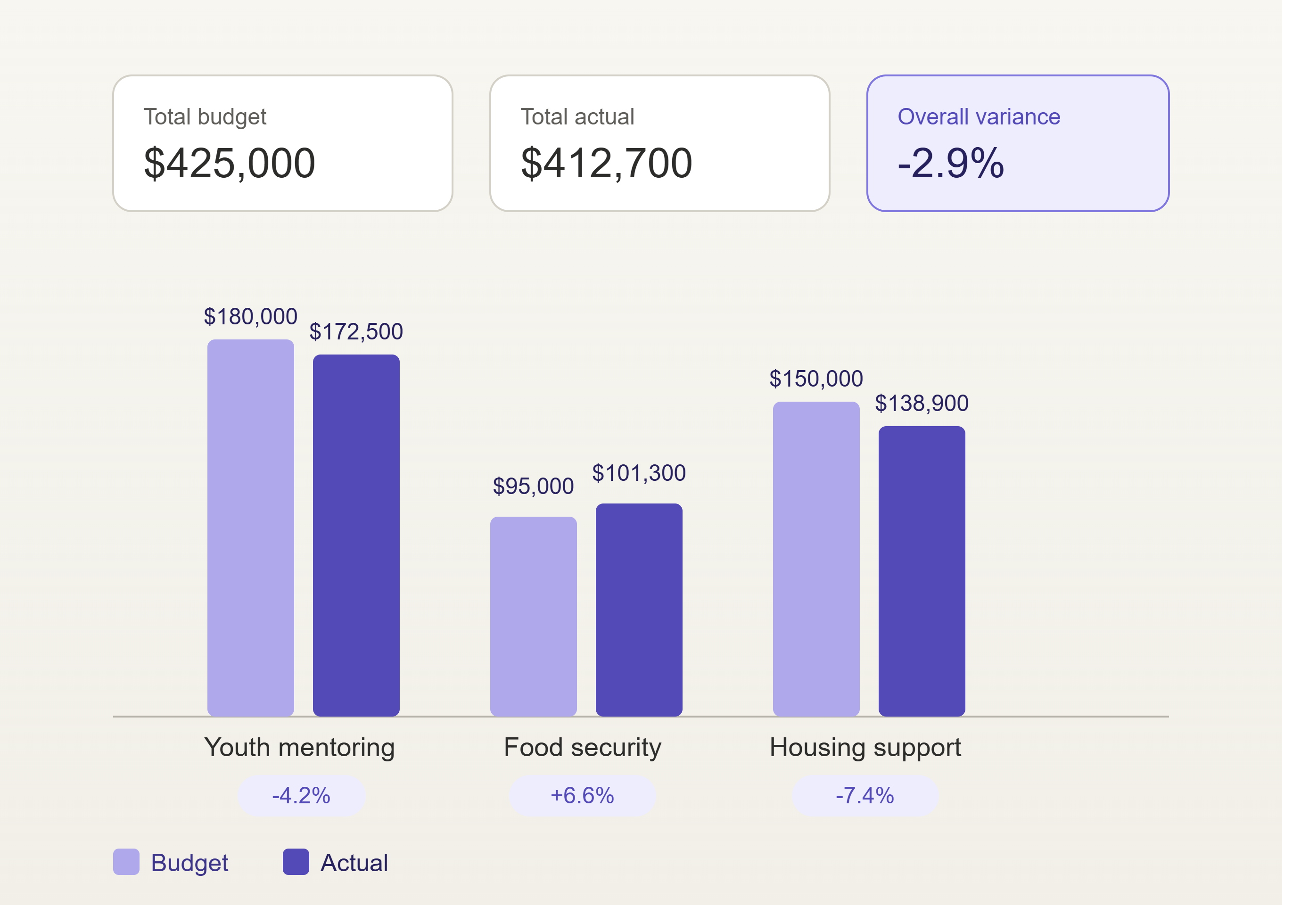
At its core, a Budget vs. Actual (BvA) report does exactly what it sounds like: it lines up what you planned to spend and raise against what you actually spent and raised, usually broken out by program, department, or fund, and often by month or quarter.
The output is a variance: the dollar or percentage difference between budget and actual for every line item. That variance is the real story. A budget is a hypothesis about the future. Actuals are the facts. The gap between them tells you whether your hypothesis was right, and if not, why.
Why It Matters More for Nonprofits
For-profit companies watch Budget vs. Actual to protect margins. Nonprofits watch it for a different, often higher-stakes reason: stewardship.
1. You're spending other people's money, on their behalf, for a purpose they trusted you with. Donors, foundations, and government funders give money with specific expectations attached sometimes explicitly, through restricted grants, and sometimes implicitly, through the mission itself. A Budget vs. Actual report is the mechanism that proves those funds went where they were supposed to go.
2. Nonprofit budgets are promises, not just forecasts. When a board approves a program budget, they're not just modeling the future they’re committing to a set of outcomes for the community the organization serves. Tracking actuals against that budget is how an organization keeps that commitment honest.
3. Restricted funding makes variance analysis more complex and more important. Unlike most businesses, nonprofits often manage multiple revenue streams with different rules attached: unrestricted operating funds, temporarily restricted grants, endowment draws. A Budget vs. Actual report broken out by fund is often the only way to see whether an organization is staying compliant with donor restrictions in real time, rather than discovering a problem at audit.
4. It's often the first thing funders and rating agencies want to see. Foundations doing due diligence, and platforms like GuideStar/Candid or Charity Navigator, increasingly look past 990 to ask whether an organization's actual financial management matches its stated plans. A clean, well-explained Budget vs. Actual process signals operational maturity.
What a Variance Actually Tells You
A common misconception is that any variance is a problem to be fixed. Variances fall into a few different categories, and telling them apart is the whole skill of financial management:
Timing variances A grant payment lands in Q3 instead of Q2. The money is fine; the calendar was wrong.
Volume variances A program served more people than expected, so both revenue and cost ran over budget together. This is often good news, not bad.
Efficiency variances the program spent less per person served than planned, freeing up capacity elsewhere.
True overspend or underspend the budget assumption was simply wrong, or spending is out of control, or a program is understaffed and unable to spend down its allocated budget even though the need is still there.
The job of a finance leader and increasingly, of program directors who understand their own numbers is to look at every meaningful variance and ask "why," not just "how much."
How to Build a Budget vs. Actual Process That Actually Works
Review it monthly, not just at year-end. Waiting until the annual audit to reconcile budget and actual means problems get discovered nine months too late to fix. Monthly or at minimum quarterly review turns BvA from a compliance document into a management tool.
Break it out by program and by fund, not just organization wide. An organization-wide number can look perfectly healthy while one program is quietly running out of restricted funds and another is sitting on an underspent grant that needs to be reallocated or returned.
Set a variance threshold that triggers a conversation. Many nonprofits use a simple rule: any line item more than 10% or $5,000 off budget (whichever is smaller) gets a written explanation from the program lead. This keeps the report from becoming a wall of numbers nobody reads.
Bring program staff into the conversation, not just finance. The people who can best explain why a number is off are usually the people running the program, not the people running the spreadsheet. The best BvA reviews are a conversation between finance and program leadership, not a memo from one to the other.
Use it to build next year's budget. A Budget vs. Actual report is, among other things, a year of evidence about how accurate your assumptions were. Organizations that feed that evidence back into the next budget cycle tend to see their variances shrink and their forecasts, and their credibility with funders, improve year over year.
The Bigger Picture
Budget vs. Actual reporting can feel like a purely technical exercise, but at a nonprofit, it's really a form of storytelling. It's how an organization proves to its board, its funders, and itself that its resources are going where its mission says they should. Done well, it doesn't just protect against financial risk. It builds the kind of trust that keeps donors giving, funders renewing, and missions moving forward.
← All insights
Nonprofit Finance
Budget vs. Actual: Why This Simple Report Is One of the Most Important Tools a Nonprofit Has
Variance isn't failure — it's feedback. The companies that win are the ones that read it fastest.
Join the conversation
Comments
Share a thoughtful question or perspective. Comments are reviewed before they are published.